A hydraulic cylinder comes in for a routine rebuild. The original head gland is retained by an interference fit and locking wire, an arrangement that makes removal difficult when the gland seizes inside the bore. What should be a straightforward maintenance task now requires special tooling and additional repair time.
The component may have performed as expected in operation. The difficulty emerges when someone has to take it apart. And that difficulty matters, because the time, complexity and risk involved in returning equipment to service are also part of the reliability equation.
A durable component can still cost you reliability
Reliability is usually judged by how long equipment runs between interventions. How safely and efficiently the component can then be accessed, removed, repaired, reassembled and returned to service is a different performance consideration, but one that contributes to the same operational objective: keeping equipment available.
Earlier in this series we looked at how reliability affects safety by determining how often people are forced into unplanned intervention. This article picks up the next step: when intervention is unavoidable, has the equipment been designed to make that work predictable and manageable?
What the intervention asks of a crew
Repair time is only part of maintenance duration. Before work starts, the equipment has to be isolated and made safe to access. Afterwards, the component has to be installed, adjusted where required and checked before the equipment returns to production.
Component design directly influences the complexity of maintenance. Accessibility, retention mechanisms, tooling requirements and handling arrangements can determine how efficiently a component is removed, repaired and returned to service, even when its operating life is comparable to alternative designs.
Those differences can also influence safety exposure. More complex interventions may require additional handling, access or time spent performing maintenance tasks, making the controls surrounding the work particularly important.
A repair can also introduce the next failure. A component that is hard to position, align, torque or adjust correctly also gives the crew more opportunities to get it slightly wrong. Bearings that are difficult to seat, seals that are easily damaged on installation and fasteners that are awkward to reach all fall into this category. Equipment may return to service with an undetected assembly issue that contributes to premature wear or failure.
Reliability engineers know this as maintenance-induced failure: where correct positioning, alignment or assembly is difficult to achieve, the potential for installation error can increase. If that error goes undetected, the equipment may return to service with a condition that contributes to premature wear or failure.
Two sides of availability
Reliability and maintainability are closely related aspects of equipment performance. Reliability concerns how consistently equipment performs its intended function over time and operating conditions, while maintainability concerns how readily it can be restored to service when intervention is required. Together, they influence availability, understood as the proportion of time equipment is ready to operate when needed.
Improving component reliability can extend the time between failures, while improving maintainability can reduce the time required to restore equipment to service. Both can contribute to availability, although the final outcome will depend on the application and the broader maintenance process.
Engineering for maintainability
Maintainability belongs alongside wear life, strength, fit and performance when a component is evaluated or re-engineered. While ease of maintenance cannot come at the expense of mechanical performance, design decisions should also consider the work required when a component eventually needs attention.
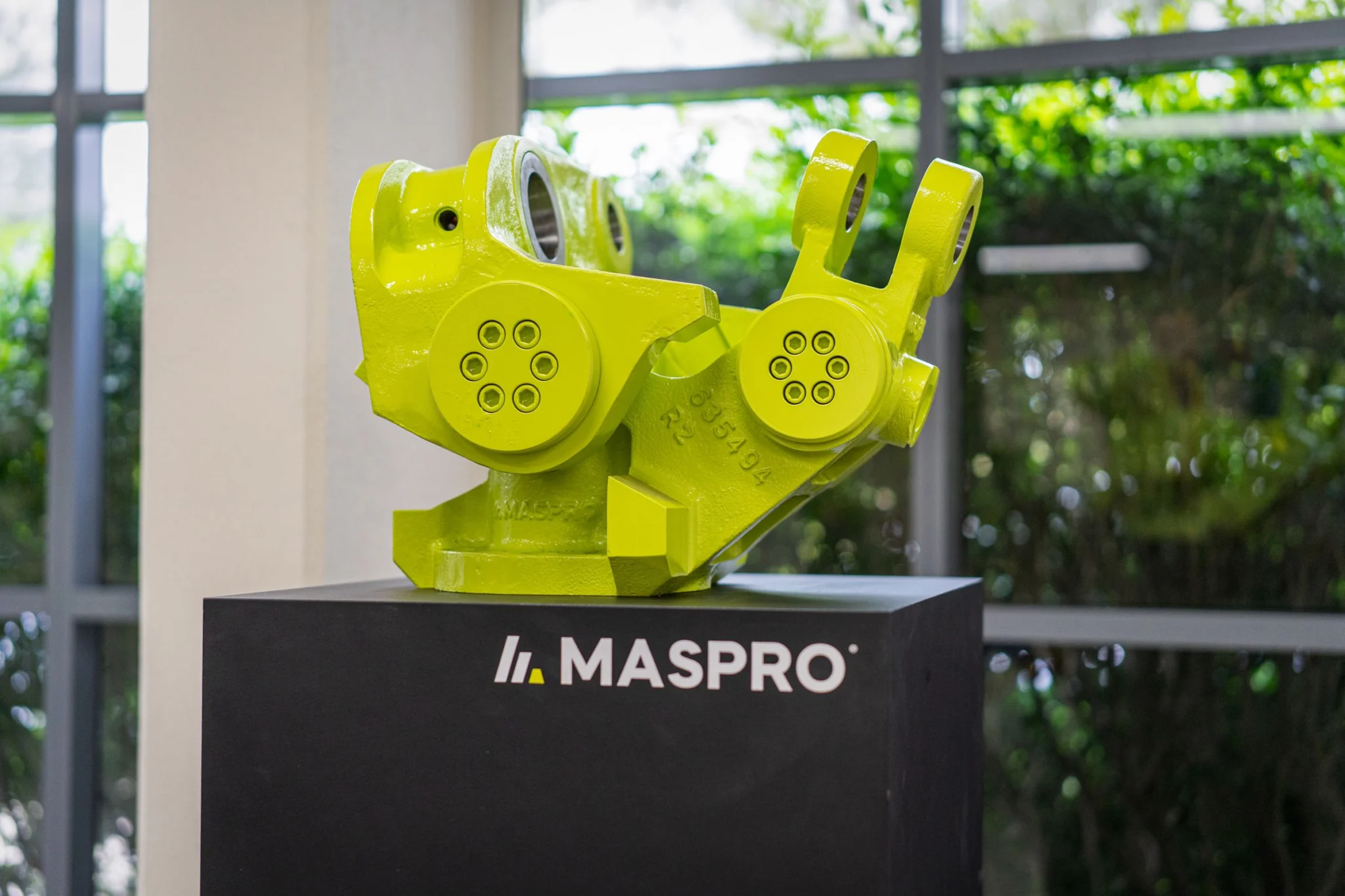
Depending on the application, those decisions may involve component interfaces, retention arrangements, accessibility or assembly requirements. MASPRO’s breakout cylinder redesign demonstrates this principle in practice. The original cylinder incorporated a head gland retained by an interference fit and locking wire. This arrangement was prone to seizing inside the bore, making removal difficult and requiring specialised tooling.
MASPRO re-engineered the cylinder with a threaded head gland that can be removed and installed using the appropriate tooling. The improvement addresses more than the component itself. It considers the maintenance intervention and how the design can make servicing more straightforward.
Redefining Reliability
Two components with the same service life and the same purchase price can place very different demands on a maintenance team over the life of the equipment. Comparing unit price and rated hours alone will not reveal that difference.
Reliability, as MASPRO defines it, includes control over what happens once intervention becomes necessary. A longer-lasting component can reduce how often intervention is required. A design that considers maintainability can help make those interventions more straightforward, predictable and manageable.
If two components deliver the same service life, how do you determine which one will cost more to maintain over its lifecycle?