Featured in AUSTRALIAN MINING
MASPRO is helping mining operations better understand what drives component life in demanding operating environments.
A hydraulic cylinder that fails after a week underground should prompt an investigation. But in demanding environments, repeated early failure can gradually become accepted as part of normal operations.
When repeated failures begin to shape operating expectations, opportunities to improve performance can be harder to identify.
“Every operation develops its own expectations around component life based on its operating environment and experience. Because we work across hundreds of sites, we’re sometimes able to share examples of what’s being achieved elsewhere.” MASPRO category lead underground Australia Roxanne Bekker told Australian Mining.
What one mine considers normal may differ significantly from performance achieved elsewhere.
“They’ll say, ‘This item lasts us three months,’ and we’ll say, ‘That’s interesting, because we’ve seen the same component achieve six months or even a year at other operations,’” Bekker said.
“Our role is to help customers understand what’s possible in their operating environment.”
Bekker has that conversation most weeks, working through how long a component should last against how long it actually does.
One recent example involved a mine that had trialled a number of different cylinder solutions over time, each presenting its own trade-offs between service life and replacement cost.
Some repaired cylinders lasted around three months on a good run, but as little as one to two weeks at the other end of the spectrum.
Rather than focusing on the purchase price alone, Bekker worked with the site to evaluate the overall operating outcome, including service life, replacement frequency and the longer-term cost of maintaining the equipment.
“The focus was on understanding performance over time, rather than comparing purchase prices,” Bekker said.
“Following a successful trial, we completed an ROI assessment and found the site had reduced its cylinder-related costs by 54 per cent over 12 months. The savings came from longer service life and fewer replacements.”
For Bekker, the financial saving was only one measure of success.
Longer component life also meant fewer replacements, reduced maintenance intervention and improved equipment availability.
MASPRO has been manufacturing aftermarket components for underground and surface hard-rock mining equipment in Condobolin, New South Wales, since 2006. Over that time, the company has built the broad customer base that allows it to compare performance across different mining operations.
Bekker has found that when the very same component can last twice as long at one site as it does at another, those differences often come as a surprise.
Conversations don’t always result in a different component. At times they uncover maintenance practices, operating conditions or application-specific factors that may be affecting performance.
“Sometimes the best outcome isn’t selling a component,” Bekker said.
“It’s helping a customer understand why performance differs between sites and giving them the information to make a better decision.”
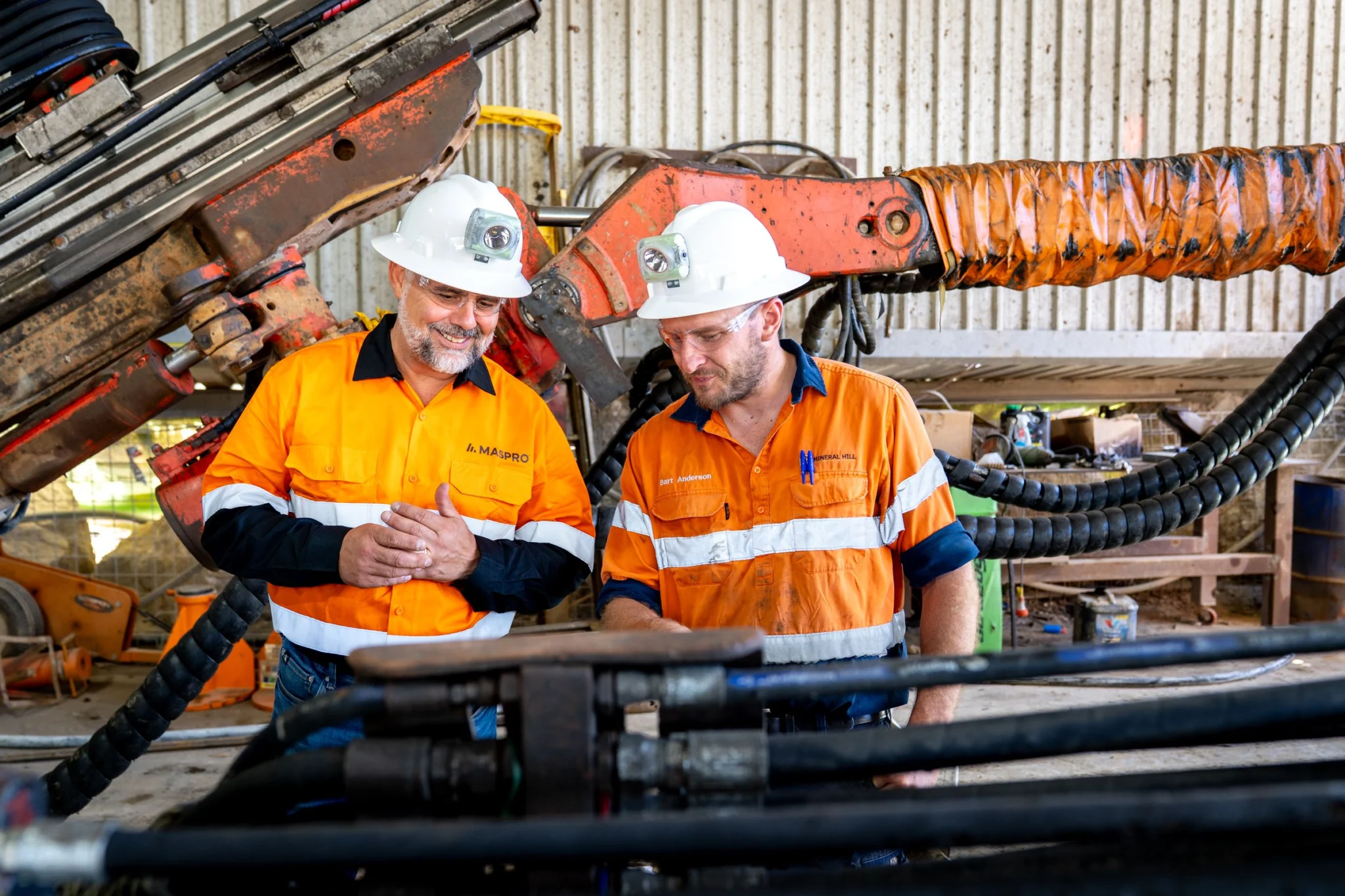
It’s understanding those differences, Bekker said, that requires time on site with customers, even though time is often their scarcest resource.
“They’re always short on time, and that makes it even more valuable,” Bekker said.
Bekker said simplifying procurement and installation can also ease the burden on maintenance teams, allowing them to spend less time sourcing parts and more time keeping equipment operating. The benefit goes beyond making components easier to source or install. Bekker said many customers value engineering support alongside the product itself, particularly when time pressures leave little room for trial and error.
“You have the parts, the parts are well priced, the parts are in stock and the parts are good quality, but if you don’t offer the level of support customers need, what you’re offering is incomplete,” Bekker said.
“You need to have someone who answers the phone, responds within the same day and really helps you understand the problem or figure out a solution.”
After six years in the role, Bekker’s measure of what turns a supplier into a partner is simple.
“Really listening more than you talk. It’s truly listening to each client and each site individually,” she said.
“It’s solving their problems if you can, being straight up if you can’t, and providing a recommendation.
“It’s consistent quality and consistent service, but it’s also maintaining that relationship not only through the good times, but being there when things go wrong and taking as much of the burden off them as you can.”