In real operations, equipment rarely fails because of a single part. It fails because systems are pushed beyond ideal conditions: misalignment, wear, heat, vibration, human variability, and time.
Yet much of the industry still talks about reliability as a product feature — something you can specify, rate, or claim.
At MASPRO, we see reliability differently. We see it as a system outcome, shaped by how equipment is designed, installed, operated, maintained, and supported over its entire lifecycle.
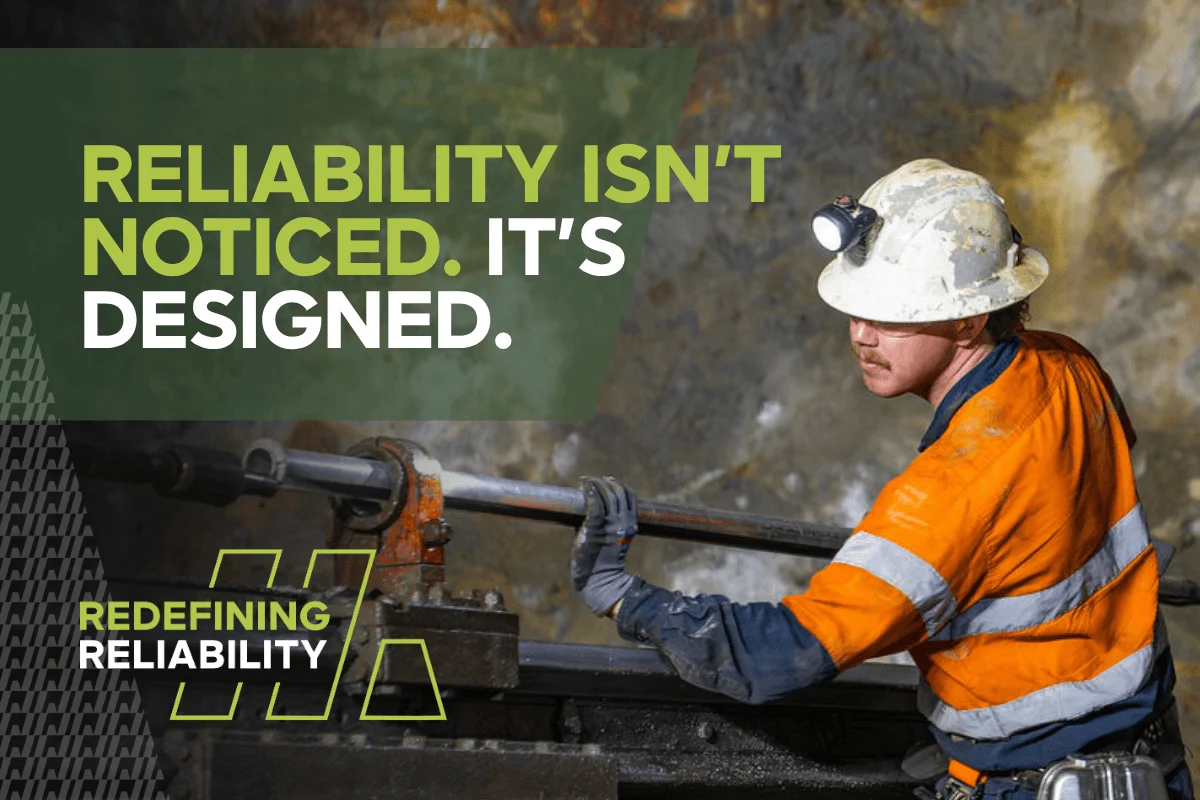
This article marks the beginning of how we are redefining reliability – grounded in real operating conditions, measurable outcomes, and the realities mining operations face every day.
The limitation of “did it last?”
Reliability is still commonly discussed in binary terms:
- The part failed
- Or it didn’t
If it exceeded expected life, it’s considered reliable. If it didn’t, it’s replaced, and the operation moves on. The problem with this framing is that it ignores failure modes. A component can meet its nominal service life and still:
- Transfer excessive load into adjacent assemblies
- Fail without detectable precursors
- Degrade in a way that accelerates wear elsewhere
- Require repeated intervention in high-risk areas
- Introduce variability into maintenance planning
From an engineering standpoint, these are not neutral outcomes. They are indicators that the system is operating closer to its limits than it appears. Durability alone does not equal reliability – particularly in high-cycle, high-variability mining environments.
Reliability is an emergent system behaviour
In real operating conditions, reliability is not determined by a single component in isolation.
It emerges from the interaction between:
- Design assumptions and actual duty cycles
- Load paths and alignment conditions
- Material behaviour under cyclic stress
- Installation quality and maintenance access
- Detection capability before functional failure
This is why two components with identical specifications can perform very differently in service. The operating context – vibration, contamination, shock loading, operator behaviour – fundamentally alters how and where failure initiates.
From a systems perspective, a “reliable” component behaves predictably within those conditions, not just one that survives them.
The costs that don’t appear on a purchase order
Most operations are good at tracking first-order metrics:
- Unit price
- Lead time
- Availability
What’s harder to quantify – and often ignored – are second-order effects:
- Additional maintenance hours caused by poor failure progression
- Increased exposure during repeated change-outs
- Collateral damage to mating parts or structures
- Planning disruption caused by non-predictable degradation
- Risk introduced when early warning signs are absent or unclear
These costs rarely appear on a procurement line item, but they accumulate rapidly across a fleet. From an engineering risk perspective, unpredictable failure is almost always more expensive than earlier, controlled intervention – even if the component technically “lasted”.
Reliability as risk control
A more useful, engineering-led definition of reliability asks different questions:
- How does this component degrade over time?
- Are the dominant failure modes understood and controlled?
- Does the design provide detectable indicators before loss of function?
- What happens to the surrounding system when it fails?
Does failure increase or reduce overall system risk?
Under this definition, reliability is not about maximising life at all costs. It’s about controlling variability, managing failure behaviour, and protecting the system when conditions deviate from ideal. In mining, deviation from ideal conditions is not the exception – it’s the norm.
Moving beyond hero performance
Chasing maximum wear life can be tempting. Longer intervals feel efficient. But from a systems engineering perspective, the goal is not hero performance from individual components. The goal is stable, predictable behaviour across the asset lifecycle, even as conditions change.
Reliable systems:
- Fail in known ways
- Degrade at measurable rates
- Allow intervention before escalation
- Reduce exposure during maintenance
- Protect adjacent components when limits are reached
These outcomes don’t come from optimistic assumptions. They come from conservative design choices, an understanding of real operating conditions, and a clear view of consequence.
A final engineering question
If reliability is only assessed at the point of failure, it’s being evaluated too late.
A more useful question is: When this component eventually degrades or fails- and it will – what does that failure do to the system, the people working on it, and the operation around it?
That answer tells you far more about reliability than service life alone ever will.