

Recurring maintenance often becomes accepted as normal long before it is recognised as a reliability issue. Discover how an engineered feed rope upgrade helped reduce replacements, lower maintenance burden, and improve operational stability across an underground jumbo fleet.

Over time, crews adapt around the disruption instead of eliminating it. That pattern was emerging across a fleet of underground development jumbos operating in hard-rock conditions, where feed rail ropes were requiring increasingly frequent replacement under high vibration, cyclic loading, and abrasive operating environments.
The ropes were not failing dramatically. But maintenance teams kept returning to the same issue.
Replacement activity had become routine. Downtime was being absorbed into maintenance schedules. The operational burden was growing quietly in the background.
Annual feed rope consumption had reached 188 units, while Rope 2470 usage had climbed to 76 units across the fleet. The financial cost mattered, but the operational consequences were more significant.
Frequent intervention increased maintenance workload, disrupted planning, and created additional manual handling exposure in confined underground environments.
Importantly, none of it initially stood out as abnormal. That is often how reliability challenges persist underground.
Not because operations ignore them, but because recurring maintenance behaviour gradually becomes embedded into the way the site operates.
The issue stops being viewed as a reliability problem and starts being treated as operational routine. Rather than focusing only on the rope itself, the engineering response examined the broader reliability conditions influencing performance underground.
Attention shifted toward fatigue behaviour under cyclic loading, rope end configuration performance, wear progression, and how the assembly behaved under real operating conditions.
The resulting engineered upgrade introduced redesigned rope end configurations, improved rope construction, and material enhancements informed directly through underground operational feedback.
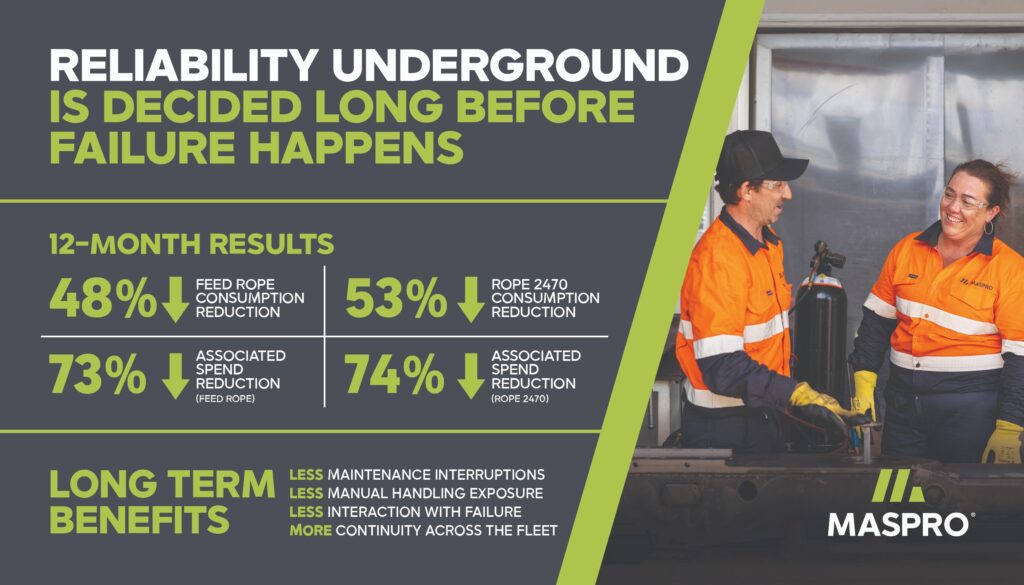
The solution was trialled across three development jumbos before wider implementation. Over the following 12 months, feed rope consumption reduced by 48 per cent, falling from 188 units to 98. Rope 2470 usage reduced by approximately 53 per cent, dropping from 76 units to 36. Associated spend reductions reached 73 per cent and 74 per cent respectively.
But the larger outcome was operational stability.
Lower replacement frequency reduced maintenance interruptions, improved continuity across the fleet, and reduced the amount of time crews spent managing recurring failure behaviour.
That distinction is important because reliability in mining is often measured too narrowly. A component does not need to fail catastrophically to create operational risk. If maintenance teams are repeatedly required to intervene, operational disruption still accumulates through labour exposure, schedule interruption, and reduced maintenance control.
True reliability is reflected in how predictably equipment systems perform under real operating conditions — especially in environments that are harsh, variable, and operationally demanding.
The outcome also reinforced the value of engineering responsiveness.
When engineering, manufacturing, and operational feedback remain closely connected, reliability improvements can be assessed and refined quickly in live operating environments.
In underground mining, reducing the delay between identifying a reliability issue and improving the solution is itself part of operational reliability. The objective is not simply extending component life.
It is reducing how often the operation has to interact with failure behaviour in the first place.
“The most valuable reliability improvements are often the ones that remove repetitive operational burden before it becomes accepted as normal,” MASPRO sales manager Peter Lowenhoff said.
Sandvik is a registered trade mark of Sandvik AB. MASPRO is not affiliated with, endorsed by, or authorised by Sandvik. All references are for compatibility identification purposes only.
Reliability isn't measured only by component life. MASPRO's engineering-led approach helps mining operations reduce recurring maintenance activity, improve equipment predictability, and minimise the operational disruption caused by repetitive component replacement.
